


Pelvic Pain and Endometriosis: How Advanced Imaging Breaks the Cycle of Misdiagnosis for Pune Women
Anjali leaned against her office desk in Hinjewadi, clutching a hot water bag to her abdomen as if her life depended on it. It was a scene that repeated itself every 28 days like clockwork. Her colleagues would offer sympathetic smiles, murmuring about “bad period cramps,” while she secretly wondered how other women managed to exist while feeling like their internal organs were being twisted by barbed wire. “It’s just part of being a woman,” her elders had told her since she was sixteen. “Take a pill and rest; it’ll pass.”
But for Anjali, the pain wasn’t just a monthly visitor; it was a squatter taking over her life. By the time she walked into Insight Imaging Clinic, she wasn’t just looking for a scan—she was looking for a reason to believe she wasn’t “exaggerating.” What she discovered was that her “cramps” were actually Endometriosis, a condition that had been ticking like a silent bomb inside her for nearly a decade. At Insight Imaging & Bone, Joint & Spine Clinic, we see this story play out in every neighborhood from Wakad to Ravet. In Pune, the cultural “normalization” of menstrual pain is the biggest barrier to diagnosis, and it is time to talk about why your “bad period” might be something much more serious.
The “Normalcy” Trap: What to Look for Before the Pain Explodes
Before Anjali met Dr. Snehal Suryawanshi, she spent years trying to figure out if her pain was “standard” or “special.” Severe, life-altering pain is never normal, yet many women wait until they are immobilized before seeking help. You should begin monitoring your body for “Killer” cramps that don’t respond to standard over-the-counter painkillers and force you to miss work or social commitments. Beyond the cycle itself, you might notice sharp twinges during ovulation or deep pelvic pain that lingers long after your period has ended.
Another common “silent” symptom is digestive distraction; pain during bowel movements or urination that worsens during your cycle is often misdiagnosed as simple “Pune acidity” or IBS, when it is actually tissue inflammation. If you are experiencing a heavy, soul-crushing tiredness that feels more like a physical weight than just sleepiness, your body is likely fighting an internal inflammatory battle. The reason Endometriosis is so frequently misidentified is that it is a “chameleon” disease. In this condition, tissue similar to the lining of the uterus grows outside the uterus—on the ovaries, fallopian tubes, or even the bowels. During a period, this misplaced tissue bleeds just like the uterine lining, but because it has no way to exit the body, it causes intense inflammation and internal scarring.
The Roadmap to Relief: Your Recovery Keys
For years, Anjali was told her ultrasound reports were “clear” by various general clinics. This happens because standard, hurried scans often miss the subtle “powder-burn” lesions or deep infiltrative spots that characterize Endometriosis. It takes a specialized eye and high-end technology to see through the biological fog that covers these lesions. When Anjali finally saw the images of her “silent bomb” on the screen at Insight Clinic, she didn’t feel despair—she felt validated. Her recovery began the moment her pain was finally given a name.
If a scan at Insight Clinic confirms Endometriosis, your first key to recovery is an immediate referral to a gynecologist who specializes in laparoscopic excision. We provide the detailed imaging reports and “maps” they need to plan a precise surgery. Following a diagnosis, your focus should shift toward an anti-inflammatory lifestyle. Choosing an “Endo-friendly” diet—low in processed sugars and high in local greens—can significantly help manage the baseline pain. Finally, because Endometriosis can be persistent, we recommend regular Pelvic Sonography to ensure that any new lesions or cysts are caught in the “symptomless stage” before they have a chance to cause debilitating pain again.
The Insight Solution: How Dr. Snehal Detects the “Invisible”
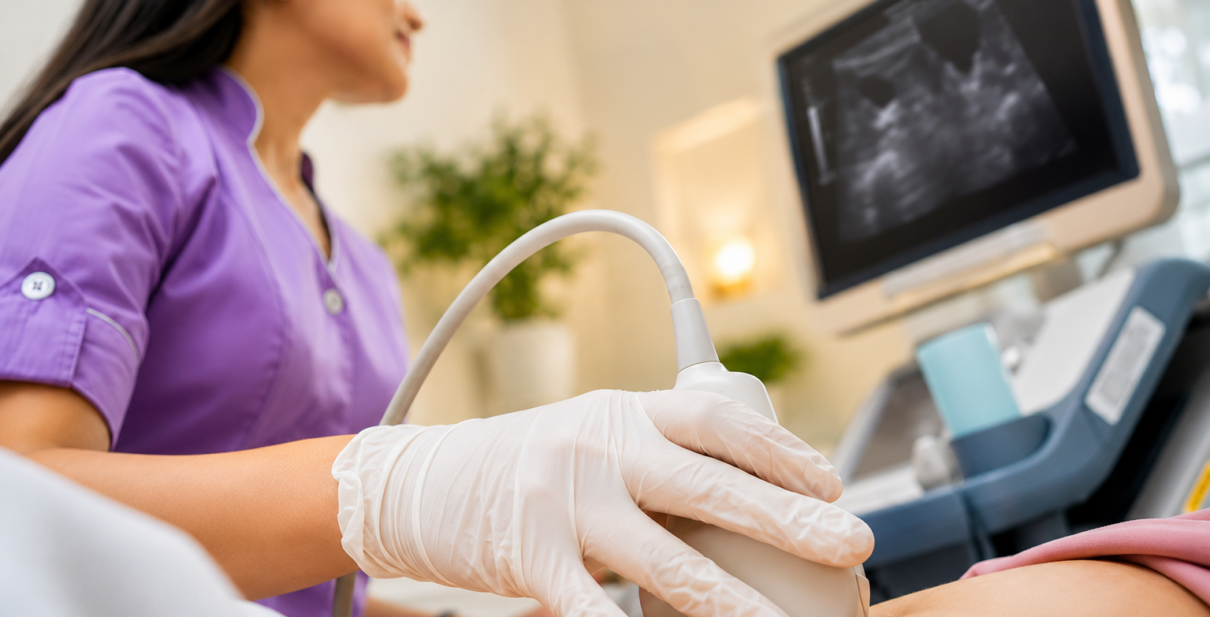
Under the leadership of Dr. Snehal Suryawanshi (MBBS, DNB Radiologist), Insight Clinic in Thergaon specializes in finding the answers that others overlook. Instead of a surface-level check, Dr. Snehal performs a meticulous “pelvic mapping” of the entire cavity. Using high-resolution ultrasound, she specifically looks for Endometriomas, often called “chocolate cysts,” which are classic markers of the disease that often hide behind other organs.
We further integrate Color Doppler to assess the blood flow and vascularity of any detected masses. This high-level detail helps differentiate between a simple functional cyst that might go away and complex endometriotic tissue that requires intervention. With 12 years of experience, Dr. Snehal understands that “normal” on a screen doesn’t always mean “healthy” in the body, which is why she listens to the patient’s history as much as she looks at the monitor. Anjali’s journey from Hinjewadi office pain to clinical clarity changed her life. She stopped blaming herself for being “weak” and started treating her body with specialized care.
Stop Calling it “Just Cramps”
Insight Imaging & Bone, Joint & Spine Clinic Expert: Dr. Snehal Suryawanshi (Radiologist)
Location: 107, B-Square, Barne Corner, Opposite Atithi Pure Veg, Thergaon, Pune.
Appointments: 8855871212 / 09511763474
Specialized Services: Pelvic Sonography, Anomaly Scans, Sonomammography.