


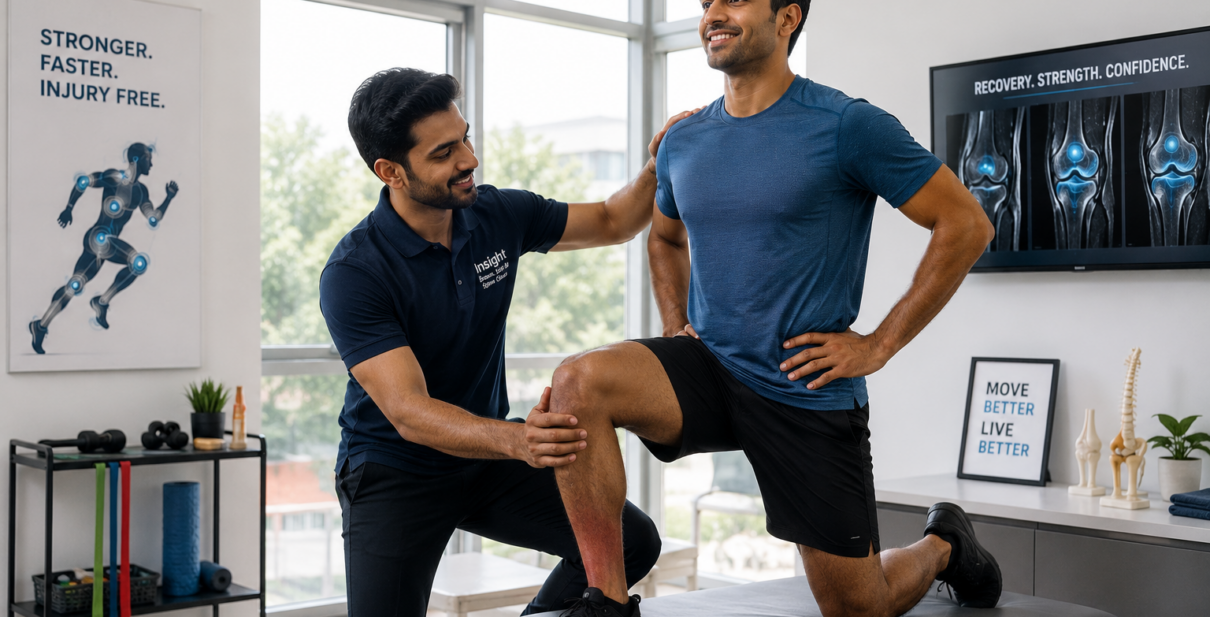
The “Internal Map” of an Athlete: Mapping Injury Before the Snap
Vikram stood on the sidelines of a local football turf in Balewadi, adjusting his knee brace for the tenth time. At 28, he was one of the fastest amateur strikers in his league, but lately, every “snap” of direction—every sudden sprint or pivot—felt like he was gambling with his ACL. He’d seen a doctor who told him it was likely just “runner’s knee,” but Vikram knew his body. He could feel a strange friction, a silent mechanical hitch that didn’t show up on a basic physical exam.
“It doesn’t hurt when I’m sitting here,” he told himself. “But the moment I load my weight to sprint, something is wrong.”
Vikram was living with an incomplete “Internal Map.” He knew where it hurt, but he didn’t know why. Like many athletes in Pune, from weekend cricketers to professional marathoners, he was trying to treat a structural problem with guesswork. At Insight Imaging & Bone, Joint & Spine Clinic, we specialize in creating the high-definition map an athlete needs to stay in the game and avoid the “big snap” that ends a season—or a career.
The “Dynamic” Danger: Why Static Exams Miss the Mark
The biggest challenge in sports medicine is that injuries rarely happen when you are lying still on an exam table. A “Static” exam—where a doctor moves your joint while you are relaxed—is only the first chapter of the story. Many athletic injuries, such as micro-tears in the meniscus or early-stage stress fractures, hide when the muscle is at rest.
The “Internal Map” requires looking at how the “machinery” behaves under tension. In a city like Pune, where the hard ground of local grounds can be unforgiving on the joints, “silent” injuries like shin splints or rotator cuff fraying often masquerade as simple muscle soreness. By the time it actually “snaps” during a game, the damage has usually been building for months, invisible to everything but a specialized scan.
The “Silent Whispers” of an Impending Injury
Your body is constantly sending “data” to your brain. For an athlete, learning to read these signals before the injury becomes acute is the difference between a one-week rest and a six-month surgery. You should be looking for:
- The “Morning Stiffness” Test: If your Achilles or patellar tendon takes more than 15 minutes to “loosen up” after you wake up, you are likely dealing with chronic inflammation that is weakening the fiber.
- Asymmetrical Power: Do you find yourself pushing off more with your left leg than your right? This “compensation” is a primary signal that your internal map has a localized weakness your brain is trying to protect.
- Localized Heat: After a practice session, feel your joints. If one specific spot stays hot to the touch long after the rest of your body has cooled down, that “hot spot” is an active site of micro-trauma.
The Insight Solution: How Dr. Snehal Maps the Athlete
When Vikram finally walked into our clinic in Thergaon, he met Dr. Snehal Suryawanshi (MBBS, DNB Radiologist). At Insight Clinic, we provide the “Dynamic Map” that athletes need to visualize their recovery.
High-Resolution MSK Ultrasound: Unlike an X-ray which only sees bone, our specialized musculoskeletal (MSK) ultrasound allows Dr. Snehal to see tendons and ligaments in “real-time.” She can ask you to move your joint while she watches the fibers on the screen, catching “impingements” that only happen during movement.
Digital X-Ray Precision: If a stress fracture is suspected, our Digital X-Ray provides the clarity needed to see the microscopic “hairline” cracks that older machines might miss as digital noise.
Vascular Assessment: Using Color Doppler, we can check the blood flow to a chronically injured area. Poor blood supply (ischemia) is often the reason why an athlete’s “minor” injury refuses to heal despite months of rest.
The Roadmap to Peak Performance: Recovery Keys
Vikram’s scan revealed that he didn’t have a tear—yet. He had Patellar Tendinosis, a thickening of the tendon that was causing friction. His “recovery” wasn’t about surgery; it was about precision.
- The “Load Management” Plan: Once Dr. Snehal mapped the exact spot of inflammation, Vikram could focus his physiotherapy on “eccentric loading.” This allowed him to strengthen the tendon without putting it at risk of a snap.
- Targeted Inflammation Control: Instead of taking general painkillers, Vikram used the map to apply ice and compression exactly where the “hot spot” was located, speeding up his cellular recovery.
- The 4-Week Re-Map: We recommend a follow-up MSK scan after four weeks of rehab. Seeing the inflammation recede on the monitor gives an athlete the confidence to return to full-intensity training without the “mental ghost” of a re-injury.
Conclusion: Don’t Play with a Blind Spot
Vikram returned to the turf three weeks later, but this time, he played without the brace and without the fear. He knew his “Internal Map” was clear. In the competitive sports culture of Pune, your most valuable piece of equipment isn’t your shoes or your bat—it’s your diagnostic clarity.
Dr. Snehal Suryawanshi and the team at Insight Clinic are here to help you map your injury before the snap. Play smarter, play longer, and play with the facts on your side.
Get Your Internal Map Today
Insight Imaging & Bone, Joint & Spine Clinic Expert: Dr. Snehal Suryawanshi (Radiologist)
Location: 107, B-Square, Barne Corner, Opposite Atithi Pure Veg, Thergaon, Pune.
Appointments: 8855871212 / 09511763474
Top Services: Digital X-Ray, MSK Ultrasound, Color Doppler.