


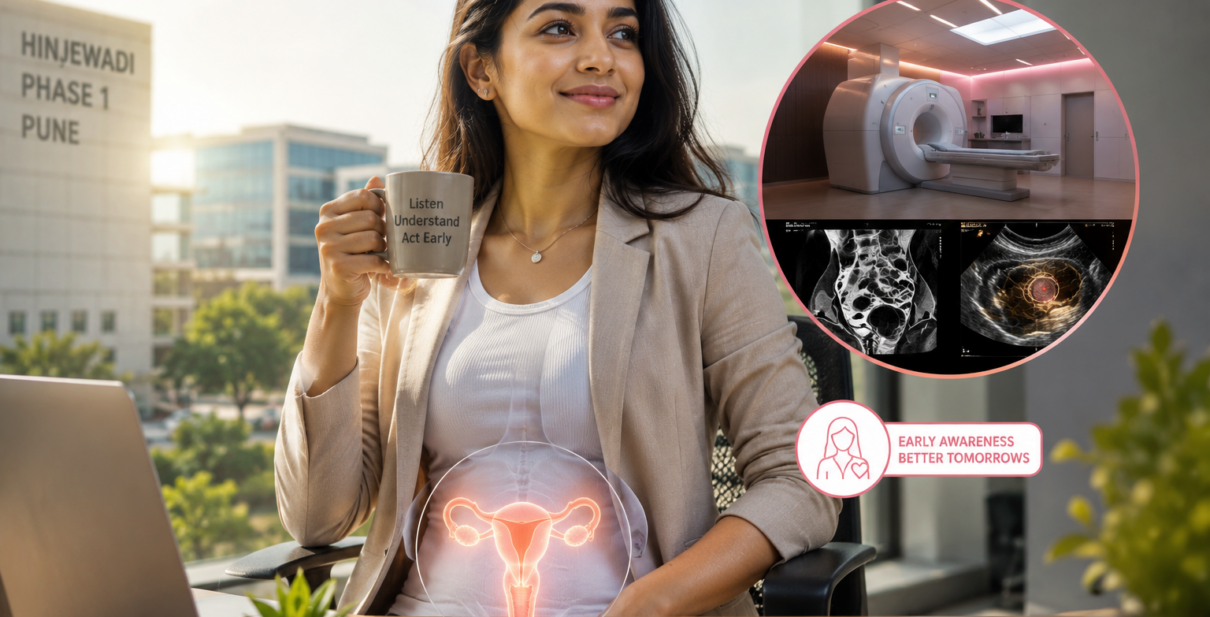
The Symptomless Stage: Why Waiting for “Pain” is the Biggest Mistake Pune Women Make
Anjali sat in her office in Hinjewadi, the fluorescent lights humming above her as she finished her third cup of tea. For months, she’d felt a subtle “fullness” in her lower abdomen—not pain, just a slight bloating that she blamed on her sedentary desk job and Pune’s oily street food.
“If it were serious, it would hurt,” she told herself every time her jeans felt a little too tight. She waited for a sign—a sharp cramp, a fever, or something unmistakable. But the body doesn’t always scream; sometimes, it whispers. By the time Anjali felt a sharp, stabbing pain three months later, the “fullness” had evolved into a large ovarian cyst that was now twisting, requiring emergency intervention.
At Insight Imaging & Bone, Joint & Spine Clinic, we call this the “Symptomless Stage.” It is a dangerous period where conditions like fibroids, cysts, or early-stage anomalies grow in silence. Waiting for pain to be your “permission slip” to see a doctor is the single biggest health mistake we see women in Pimpri Chinchwad make.
The “Silent Whispers”: What to Look for Before the Pain Starts
Your body has a language of its own. Before a condition becomes an emergency, it sends out subtle signals that are easy to dismiss in the rush of a Pune lifestyle.
The Red Flags to Monitor:
- The Persistent Bloat: If your stomach feels “stretched” or full even when you haven’t eaten a heavy meal, it’s not always indigestion.
- Frequency Shifts: Are you suddenly visiting the washroom more often? Large pelvic masses can press against the bladder, mimicking a urinary tract infection.
- Cycle Changes: Spotting between periods or a sudden change in flow—even if painless—is a primary signal that the uterine lining needs an expert look.
- The “Heavy” Feeling: A sensation of pressure in the pelvic floor when standing for long periods or after a long commute.
The “Wait and Watch” Trap
The reason the Symptomless Stage is so deceptive is biological. Many pelvic conditions, including Uterine Fibroids or Ovarian Cysts, can grow significantly before they ever touch a nerve ending or cause a rupture.
When Anjali finally visited Dr. Snehal Suryawanshi, she asked, “How could something so big not hurt until today?” The answer lies in the specialized nature of pelvic diagnostics. By the time pain arrives, the condition has often reached a stage where treatment becomes more complex. Early detection during the “quiet” phase allows for minimally invasive solutions rather than major surgeries.
The Insight Solution: How Dr. Snehal Provides a Clear Window
Under the expert guidance of Dr. Snehal Suryawanshi (MBBS, DNB Radiologist), Insight Clinic in Thergaon bridges the gap between uncertainty and a definitive plan.
- High-Resolution Pelvic Sonography: We don’t just “check for lumps.” Dr. Snehal uses advanced imaging to assess the texture of the uterine wall and the blood supply to the ovaries.
- Expert Interpretation: With over 12 years of experience, Dr. Snehal can differentiate between a functional cyst (which may disappear on its own) and a pathological one that requires action.
- Color Doppler Integration: If a mass is detected, we use Color Doppler to study the vascularity. This is critical in the symptomless stage to rule out anything more serious.
Your Roadmap to Pelvic Health: The Recovery Keys
For Anjali, recovery wasn’t just about the physical healing after her procedure; it was about changing her mindset. After your scan at Insight Clinic, we focus on these proactive recovery pillars:
- The Annual “Baseline” Check: Don’t wait for a symptom. If you are over 30 or have a family history of PCOS or fibroids, an annual Pelvic Ultrasound at Insight Clinic provides a “baseline” image. This allows us to track even 1mm changes year-over-year.
- Hormonal Harmony: Often, what we see on a scan is a reflection of lifestyle. Following a scan, focus on anti-inflammatory nutrition and stress management to prevent the recurrence of cysts or fibroids.
- Listen to the “Whispers”: If your “self-check” reveals even a minor change in your cycle or comfort, book a scan. It is better to have a 15-minute “all-clear” than a three-month “too-late.”
Conclusion: Pain is a Late Signal
Anjali’s story is a reminder that health is not merely the absence of pain. In the busy, fast-paced world of Pune, your greatest asset is a proactive approach. Dr. Snehal Suryawanshi and the team at Insight Clinic are here to ensure that your “Symptomless Stage” is caught and managed with care.
Don’t wait for the scream. Listen to the whisper.
Take Control of Your Health Today
Insight Imaging & Bone, Joint & Spine Clinic
Expert: Dr. Snehal Suryawanshi (Radiologist)
Location: 107, B-Square, Barne Corner, Opposite Atithi Pure Veg, Thergaon, Pune.
Appointments: 8855871212 / 09511763474
Specialized Services: Pelvic Sonography, Anomaly Scans, Digital X-Ray.