

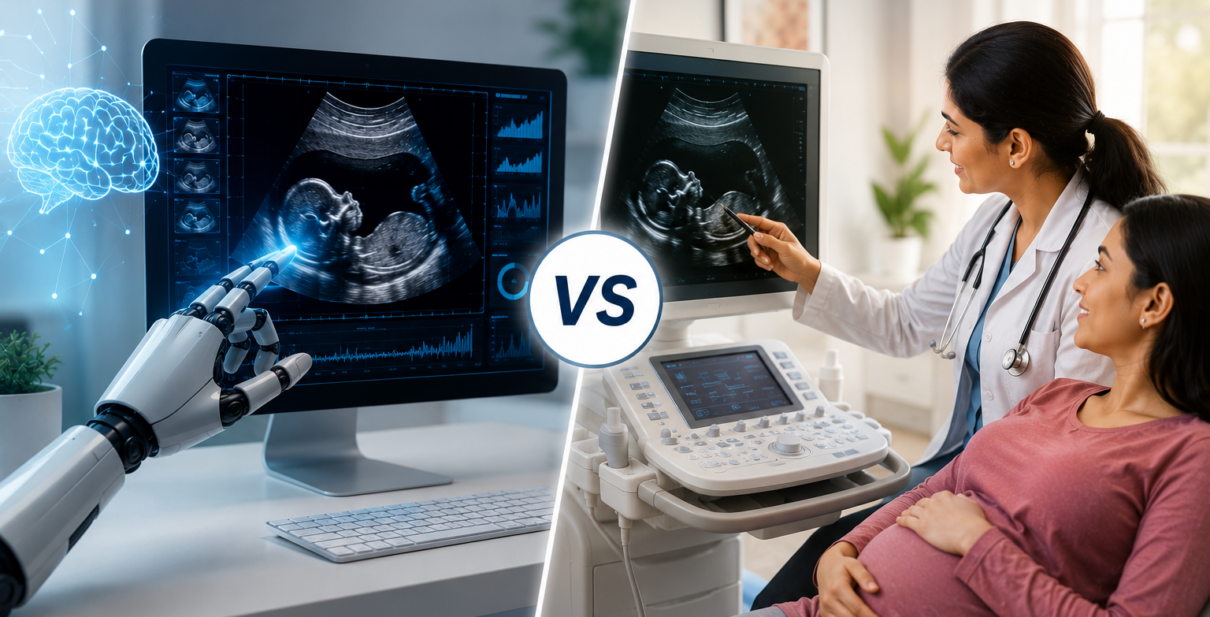
“AI vs. The Human Eye”: How Software Can’t Replace 12 Years of Experience
Rajiv sat in a brightly lit diagnostic center in Baner, watching a sleek, automated machine whir to life. He had been suffering from a nagging pain in his shoulder for months, and the clinic’s brochure boasted about “AI-powered automated reporting.” It sounded like the future—efficient, fast, and high-tech. Ten minutes later, he walked out with a computer-generated report that used a lot of big words but didn’t seem to account for the fact that Rajiv was a former state-level badminton player with a specific old injury.
“The machine says it’s ‘normal wear and tear,'” Rajiv thought, frustrated. “But I know this pain isn’t normal.” He felt like just another data point in an algorithm. Like many patients in Pune, Rajiv had fallen into the “Automation Trap”—the belief that the latest software can replace the nuanced, intuitive judgment of a seasoned medical professional.
At Insight Imaging & Bone, Joint & Spine Clinic, we see this story play out across every modality, from X-rays to advanced ultrasounds. We’ve come to realize that while AI is a powerful tool, it lacks the “Human Context” that transforms a scan into a diagnosis. It’s time we pull back the curtain on why software alone is never enough.
The “Algorithm Blindspot”: What Machines Miss
Artificial Intelligence works by comparing your image to millions of others in a database. It looks for patterns. But medicine is rarely just about patterns; it’s about anomalies. A machine can tell you if a bone is broken, but it struggles to understand why a certain shadow looks different in a patient who has a unique anatomical variation or a complex surgical history.
The “Algorithm Blindspot” occurs because software cannot ask you follow-up questions. It doesn’t notice that you winced when the probe moved a certain way. It doesn’t know that your family has a history of a rare condition that makes a “standard” shadow highly suspicious. In the hands of a technician just “pushing buttons” to feed an AI, your unique health story gets flattened into a generic average.
The “Silent Signals”: Why Experience Matters
Before a machine even begins to process an image, a veteran radiologist is already picking up on “silent signals.” At Insight Clinic, we believe the diagnostic process begins the moment you walk through the door.
The Human Edge in Diagnostics:
- Tactile Feedback: During an ultrasound, the way the tissue “gives” under the probe tells a story. A machine cannot feel the resistance of an inflamed tendon or the subtle pulse of a vascular anomaly.
- Clinical Correlation: Snehal Suryawanshi doesn’t just look at the screen; she looks at you. She correlates the “pixels” on the monitor with your physical range of motion, your pain points, and your medical history.
- Real-Time Adjustment: If a shadow looks unclear, a machine might just label it “inconclusive.” A human expert will tilt the probe, change the frequency, or ask you to shift your position to find the truth behind the blur.
The Insight Solution: Technology Empowered by Expertise
Under the leadership of Dr. Snehal Suryawanshi (MBBS, DNB Radiologist), we treat technology as an instrument, not the performer. With 12 years of clinical excellence, our approach in Thergaon is built on the philosophy that a scan is only as good as the mind interpreting it.
- Expert-Led Scanning: At many large centers, a technician performs the scan and a doctor signs the report hours later. At Insight Clinic, Dr. Snehal is often the one holding the probe. This ensures that the person interpreting the image is the same person who saw the pathology in real-time.
- High-Resolution Precision: We use the latest Digital X-Ray and Color Doppler technology, but we use it to verify our clinical suspicions, not to replace them.
- The “Whole Patient” View: Whether it’s an Anomaly Scan or a complex Sonomammography, we provide a level of detailed commentary that an automated report simply cannot generate.
The Roadmap to Clarity: Your Key Focus Points
Rajiv eventually came to Insight Clinic for a second opinion. Dr. Snehal didn’t just run the machine; she spent time understanding his badminton history and his specific pain triggers. Her diagnosis wasn’t “normal wear and tear”—it was a subtle labral tear that the AI had dismissed as an image artifact.
- The “Human First” Rule: When booking a scan, always ask: “Who is actually performing and reading my scan?” If the answer isn’t a qualified MD or DNB Radiologist on-site, you are risking an “Algorithm Blindspot.”
- Context is King: Always bring your past reports and a clear history of your symptoms. A machine might ignore a 2-year-old report, but a human expert will use it to spot “progressive” changes that are the true keys to a diagnosis.
- Demand Clarity: If your report is full of generic “templated” language, ask for a consultation. You deserve to know what those images mean for your life, not just how they fit into a database.
Conclusion: Expertise is the Ultimate Upgrade
Rajiv’s experience is a reminder that in healthcare, “newest” isn’t always “best” if it lacks the human touch. AI can process data, but it cannot practice medicine. Dr. Snehal Suryawanshi and the team at Insight Clinic provide something no software can: a decade of specialized experience and a genuine commitment to your recovery.
Don’t settle for an automated “maybe.” Get the human certainty you deserve.
Experience the Human Edge in Diagnostics
Insight Imaging & Bone, Joint & Spine Clinic
Expert: Dr. Snehal Suryawanshi (Radiologist)
Location: 107, B-Square, Barne Corner, Opposite Atithi Pure Veg, Thergaon, Pune.
Appointments: 8855871212 / 09511763474
Specialized Services: Digital X-Ray, Color Doppler, Anomaly Scan.